Key takeaways
- Fruiting body extracts contain more beta-glucans (the active fraction in most mushroom claims) than mycelium-on-grain by a wide margin.
- Mycelium-on-grain is grain plus fungal fibers - if it is not separated from the substrate, you are paying for grain starch labeled as mushroom.
- Beta-glucan percent on a COA is the cleanest single diagnostic. Above 15 percent indicates fruiting body. Below 5 percent with measurable starch indicates mycelium-on-grain.
- Pure mycelium (without grain) is a legitimate fraction. The category that is criticized is mycelium-on-grain sold whole.
- If a label says 'mushroom' without specifying which part, ask the manufacturer. If they will not say, that answers the question.
- The debate matters most for Lion's Mane and Reishi. It matters less (or not at all) for some Cordyceps militaris products that are mycelium by design.
The chemistry
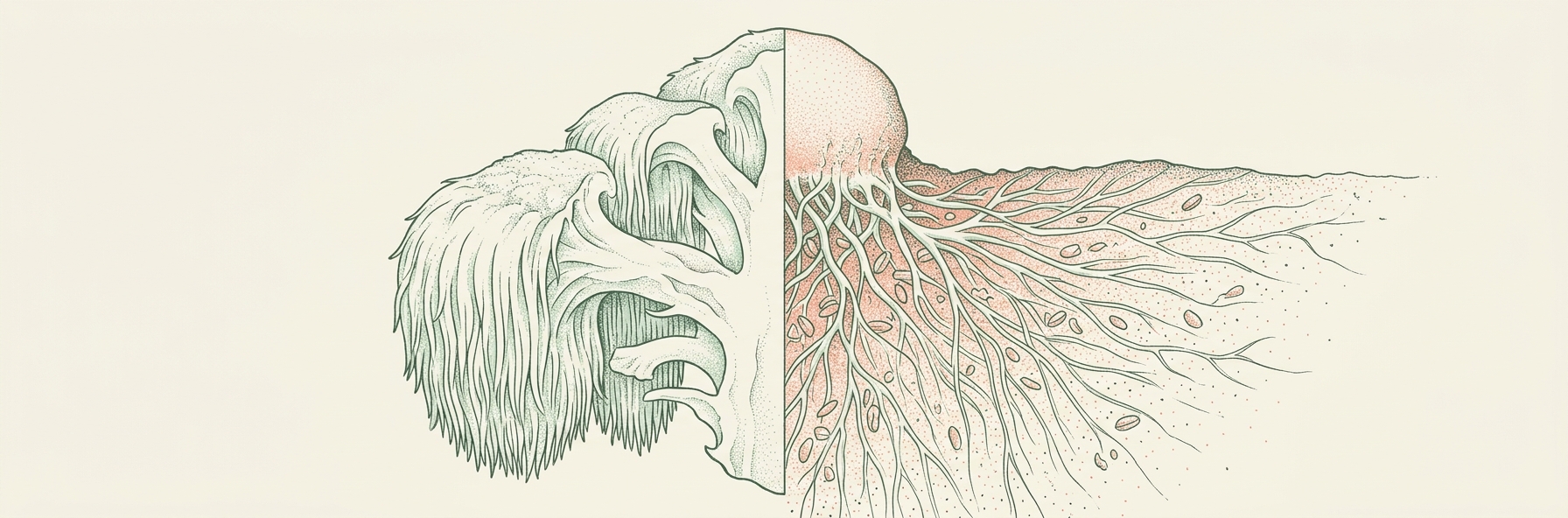
Fruiting body extracts contain higher concentrations of beta-glucans and the species-specific actives (hericenones and erinacines in Lion's Mane, triterpenes in Reishi, cordycepin in Cordyceps militaris) that drive most claimed benefits. Mycelium grown on grain dilutes the active fraction with grain starch and produces measurably lower beta-glucan content per gram. Beta-glucans are 1,3 / 1,6-linked polysaccharides found in the cell wall of the fruiting body; they are the fraction that drives most of the immunomodulatory and neurotrophic effects in the literature. The species-specific actives are different molecules entirely (hericenones are aromatic compounds in Lion's Mane fruiting body; erinacines are diterpenoids found in the mycelium of Lion's Mane), which is why a sophisticated discussion does not say 'fruiting body always wins' - it says 'fruiting body wins for the compounds you are most likely to be paying for'.
Why beta-glucans matter
Beta-glucans are the most-studied fraction across medicinal mushroom literature, with a meaningful body of human and animal trials linking them to immune modulation and (less directly) to cognitive markers via systemic-inflammation pathways. They are also the fraction that most labs have a validated assay for (the Megazyme Mushroom and Yeast Beta-Glucan kit is the industry-standard test). When a mushroom-supplement label or COA reports a beta-glucan percent, that number is comparable across products. When a label reports 'polysaccharides' instead, you cannot tell what fraction is beta-glucan versus alpha-glucan (mostly grain starch), so the number is much harder to compare and easy to inflate.
What the labels obscure
Many labels list 'mushroom' as a single ingredient without disclosing whether it's fruiting body, mycelium on grain, or a blend. The COA tells you the truth: a high beta-glucan percent indicates fruiting body; a low beta-glucan with high alpha-glucan (mostly grain starch) indicates mycelium-on-grain. Some manufacturers will list a 'polysaccharides' percentage that bundles both, which inflates the number without telling you which polysaccharide. Polysaccharides as a category includes both beta-glucans (active) and alpha-glucans (mostly starch) - a 30 percent polysaccharide claim that is 25 percent alpha-glucan and 5 percent beta-glucan is mostly grain. The label might also list an extract ratio (8:1, 10:1) without saying what was extracted, which is a separate but adjacent obfuscation.
How to read a beta-glucan number
Look for a percent of dry weight, measured by the Megazyme Mushroom and Yeast Beta-Glucan assay or an HPLC equivalent. A high-quality fruiting-body extract for Lion's Mane lands in the 25 to 35 percent range. A pure mycelium fraction (separated from the grain substrate) lands in the 15 to 25 percent range. Mycelium-on-grain sold whole typically lands at 1 to 5 percent and is mostly composed of alpha-glucans (grain starch). Reishi fruiting-body extracts standardized for triterpenes typically report beta-glucans in the 20 to 30 percent range plus a separate triterpene percent (1 to 4 percent of total triterpenes). If a label says only 'high in polysaccharides' without breaking out beta vs alpha, it is not a useful number.
The species map: where this debate matters most
Lion's Mane (Hericium erinaceus): fruiting body strongly preferred for the cognitive claims. Hericenones in particular concentrate in the fruiting body. Erinacines concentrate in the mycelium, which is why a few brands sell separated mycelium extracts standardized for erinacines specifically (legitimate, just different). Reishi (Ganoderma lucidum): fruiting body strongly preferred; triterpenes are concentrated in the cap and the spore powder, mycelium-on-grain reishi is the most-criticized product type. Cordyceps militaris: mycelium can be the right answer because the lab-cultivated form is mycelial and is what most cordycepin trials actually used. Cordyceps sinensis (different species, harder to cultivate, harvested wild): fruiting body is the traditional medicinal form but most US-market 'cordyceps' is actually militaris. Turkey Tail (Trametes versicolor): fruiting body for PSK/PSP polysaccharides. Chaga: fruiting body (technically a sclerotium, a hardened mass), and most mycelium-on-grain Chaga fails the basic chemistry comparison.
When mycelium is fine
Pure mycelium (not on grain) is a legitimate fraction. Grain-grown mycelium that has been extracted and concentrated, with the grain substrate filtered out, is also fine - the chemistry can be characterized and the beta-glucan number can hit the 15 to 25 percent range. Some Cordyceps militaris products are grown as mycelium specifically because the fruiting body is hard to cultivate at scale, and a separated mycelial extract is the practical option. Some Lion's Mane products are sold as separated mycelium specifically for erinacines. The category that is criticized is mycelium-on-grain sold whole, where the grain substrate is not removed and the labeled milligrams are mostly not mushroom.
The case for mycelium-on-grain (steelman)
Honest counter-argument worth airing. First, the grain substrate is not inert: the fungus has been digesting it, so the final material includes some fungal-derived metabolites the grain alone would not have. Second, the cost difference matters: fruiting-body extracts are 3 to 6 times more expensive than mycelium-on-grain at retail, and a price-sensitive buyer with no medicinal claim might reasonably prefer cheaper. Third, traditional cultivation in some Asian markets uses whole mycelium-grain blocks for tea preparations, so 'mycelium-on-grain is fake' overstates the case. The criticism is not that mycelium is fake, or that grain is harmful. The criticism is specific: when a label implies medicinal-mushroom potency at fruiting-body milligrams, but the product is mycelium-on-grain at 1 to 5 percent beta-glucan, the implied potency is not delivered. That is a labeling and pricing problem, not a 'mycelium is bad' problem.
What to ask the manufacturer
Five questions, in order. One: is this a fruiting body extract, a separated mycelium extract, or mycelium grown on grain and sold whole? Two: what is the beta-glucan percent on the most recent COA, and what assay was used? Three: what is the alpha-glucan percent on the same COA? Four: is the COA from a third-party accredited lab or the manufacturer's internal lab? Five: when was the latest batch tested? A manufacturer that answers these in writing has nothing to hide. A manufacturer that deflects to 'all parts are beneficial' or 'this is a marketing question' or 'we don't share that for proprietary reasons' is telling you what they cannot prove.
Brand patterns by category
Stating the category, not naming products: brands that publish per-batch beta-glucan numbers from third-party labs tend to cluster around the fruiting-body or separated-mycelium products. Brands that lead with 'full-spectrum' marketing and refuse to publish a beta-glucan percent are more likely selling mycelium-on-grain whole. Direct-to-consumer mushroom-specialty brands (Real Mushrooms, Nootropics Depot, Oriveda) tend to be more transparent than multi-supplement omnibrands selling 'a brain blend' that happens to include mushrooms. Brands that bundle five mushroom species at a token dose each (often 100 mg per species in a 500 mg total) are closer to flavor than potency. None of this is a guarantee, but it is a useful prior when you do not have the COA in hand. Always defer to the actual COA of the batch you are buying.
Decoding common label terms
Quick translation guide for the language you will see on bottles. 'Full-spectrum' or 'whole mushroom': usually mycelium-on-grain plus fruiting body, with no breakdown. 'Mycelium': could be on-grain (most likely at low price points) or separated (more likely at high price points). 'Fruiting body extract': what most evidence-aligned products use. '8:1 extract' or '10:1 extract': 8 or 10 grams of starting material concentrated to 1 gram - tells you nothing about which fraction was extracted. 'Standardized to X percent beta-glucans': this is the useful number. 'Standardized to X percent polysaccharides': less useful, includes alpha-glucans. 'Dual extract' (water and alcohol): captures both water-soluble polysaccharides and alcohol-soluble triterpenes; legitimate for Reishi and Chaga where triterpenes matter.
Why the debate persists
The mycelium-on-grain category exists for a reason: it is dramatically cheaper to produce than fruiting bodies, the mycelium is real fungal tissue (not a fake), and the marketing claim 'whole mushroom' is technically defensible if you accept that the grain-mycelium complex is one connected substrate. The criticism is not that mycelium is fake. The criticism is that labeling 100 mg of mycelium-on-grain as '100 mg of mushroom' implies a level of beta-glucan content that the product does not deliver. The debate persists because both sides have a point: the chemistry is clearly different, and the labeling rules let manufacturers paper over that difference. The FDA has not stepped in because supplement labeling is regulated under DSHEA, which sets a low bar for 'identity' but does not require disclosure of fungal anatomy.
The two-question shortcut
If you do not want to learn the entire chemistry, ask these two questions before you buy. One: does the product disclose a beta-glucan percent on the COA, ideally above 15 percent? If yes, you are getting fruiting body or separated mycelium. If no, or if the number is missing, assume the worst. Two: is the price per gram of stated active fraction (beta-glucan if disclosed, total milligrams of mushroom if not) competitive with the top transparent brands in the category? If you cannot answer either question, the label is not designed for you to answer them, which is its own answer.
FAQ
How do I know which one I'm buying?
Check the COA for the beta-glucan percent. Above 15 percent indicates fruiting body or separated mycelium. Below 5 percent with measurable starch indicates mycelium-on-grain sold whole.
Are alpha-glucans bad?
No. Alpha-glucans are not harmful. They are mostly grain starch in a mycelium-on-grain product, which means they are nutritionally identical to a small amount of oatmeal. The issue is whether you are paying mushroom-supplement prices for grain starch, not whether grain starch is unhealthy.
Does extract ratio (8:1, 10:1) matter?
Yes, but it is not enough on its own. An 8:1 extract means 8 grams of starting material concentrated to 1 gram of finished extract. The extract ratio tells you nothing about which fraction was extracted (water-soluble polysaccharides vs alcohol-soluble triterpenes) or what the final beta-glucan percent is. Pair the ratio with a COA, not the ratio alone.
Is wild-harvested better than cultivated?
Sometimes, sometimes not. Wild Chaga and wild Reishi can be excellent, but heavy-metal contamination is a real concern (mushrooms bioaccumulate metals from the substrate). Cultivated fruiting bodies grown on hardwood logs are usually safer and more consistent. The COA still matters either way - heavy-metal screening on a wild-harvested batch is more important, not less.
What about whole-mushroom powder you buy at a grocery store?
It can be fine for culinary use, but the dose for cognitive or immune effects in trials is much higher than what a tablespoon in a smoothie delivers. The trials use concentrated extracts at 1000 mg or more per day. A teaspoon of whole-mushroom powder might be 1 to 2 grams of mushroom, but the active fraction is unconcentrated, so the effective dose of beta-glucans or hericenones is well below trial levels. Treat it as food, not as supplement.
What's the deal with spore-only products?
Reishi spore powder is a legitimate but specialized product. The cracked-shell spore is rich in triterpenes (specifically, certain ganoderic acids) and is sold as a higher-potency triterpene source. It is not a substitute for fruiting body when you want beta-glucans. If a Reishi product is marketed as 'spore' but the COA shows mostly polysaccharides, the spore claim is doing marketing work the chemistry does not support.
Key sources
Direct citations for the claims above. Click through to the original.
- Wasser, S. P. (2002) - Medicinal mushrooms as a source of antitumor and immunomodulating polysaccharides
Foundational review on beta-glucan chemistry across medicinal mushroom species.
- Kozarski et al. (2015) - Antioxidants in mushroom extracts: chemistry, processing, and health benefits
Detailed review of polysaccharide profiles across processing methods.
- Megazyme Mushroom and Yeast Beta-Glucan assay protocol
Industry-standard assay used by accredited labs to differentiate beta-glucans from alpha-glucans on a COA.
- Chen et al. (2016) - Hericium erinaceus chemical composition by part
Reference for the differential distribution of hericenones (fruiting body) and erinacines (mycelium) in Lion's Mane.